
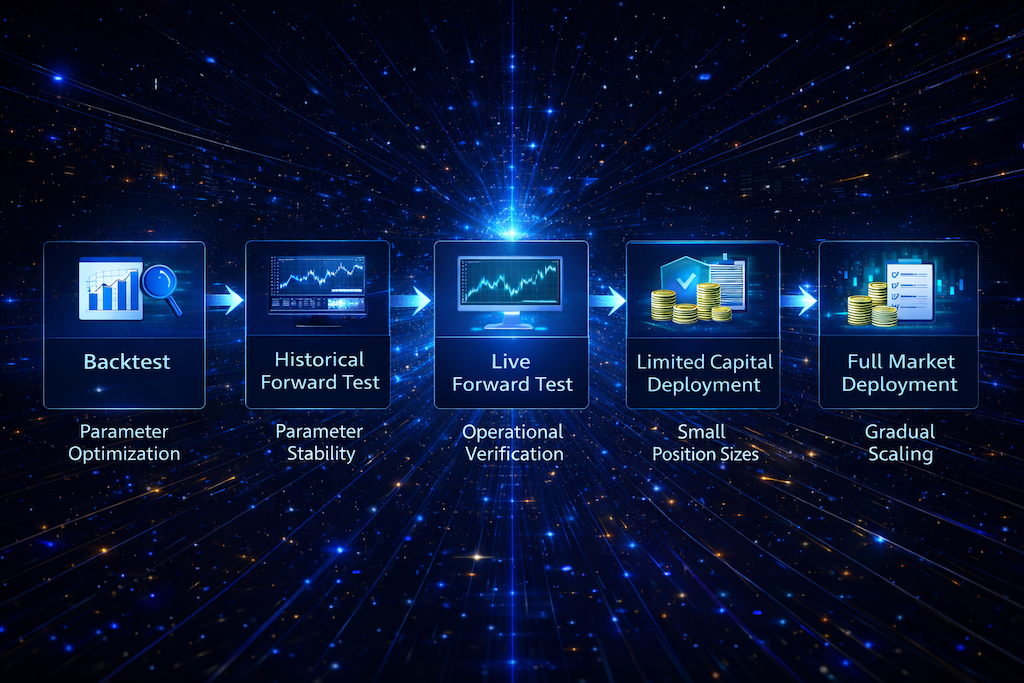
A backtest can show whether a trading idea might work. It cannot show whether the strategy is ready for production.
Most strategies fail because the validation process stops too early. A system that looks stable in historical simulation may still break when exposed to unseen data, live market conditions, or real execution environments.
For this reason, strategies should move through a sequence of validation stages before meaningful capital is deployed.
The objective is simple: each stage tests a different assumption about the system.
1) Backtest: discovering stable parameters
The first stage uses a portion of the historical dataset to develop the strategy and identify viable parameter configurations.
During this phase:
- signals are designed
- parameters are optimized
- execution logic is defined
This stage typically uses a majority of the available data. The exact proportion is not critical, but a common approach is to reserve roughly 70% of the dataset for development.
Because this dataset is used repeatedly during experimentation, it inevitably becomes part of the strategy design process. As a result, performance observed here cannot be treated as validation.
The purpose of this stage is discovery.
2) Forward test on unseen historical data
Once the strategy parameters are finalized, they are frozen and evaluated on the remaining historical data.
This dataset was not used during optimization. It acts as a forward-style evaluation where the strategy is tested on conditions it has never seen before.
In many workflows, this stage uses the remaining 30% of the historical dataset.
The objective is not to reproduce the same results seen during development. Some degradation is expected. Instead, the goal is to verify that the strategy maintains its structural behavior:
- similar trade distribution
- comparable drawdown profile
- consistent signal frequency
Strategies that collapse at this stage were likely overfitted during development.
3) Live forward testing
Even after passing the historical forward test, the system has still only interacted with recorded market data.
The next step is live forward testing, where the strategy runs in real time but with limited or no capital deployed.
This phase typically runs long enough to cover a meaningful portion of the strategy’s typical operating horizon. A common rule is to observe the system for an additional period roughly equivalent to the historical forward segment.
During this phase the system experiences conditions that historical datasets cannot replicate perfectly:
- real-time data feeds
- exchange latency
- liquidity changes
- funding dynamics
- unexpected market behavior
This stage verifies that the strategy functions operationally as expected.
4) Limited capital deployment
Once the strategy has demonstrated stability in live forward testing, capital can be introduced cautiously.
Initial deployment should use minimal position sizing, allowing the system to interact with real markets while limiting risk.
The objective here is not performance. It is operational confirmation:
- execution behaves as expected
- monitoring systems function correctly
- risk limits are respected
If issues appear at this stage, they can be corrected without significant capital exposure.
5) Scaling to full position size
Only after the strategy has demonstrated stability across all previous stages should position sizes increase.
Scaling should still be gradual and responsive to market conditions, particularly in environments such as crypto markets where liquidity and volatility can change rapidly.
Even well-tested strategies must adapt to capacity limits, execution costs, and changing market regimes.
Full deployment is not the beginning of the process – it is the final step of validation.
Why this process matters
Many trading failures occur because systems move directly from backtesting to production.
Each stage in the validation pipeline removes a different source of risk:
- backtesting explores ideas
- historical forward testing checks stability
- live forward testing verifies operational behavior
- minimal deployment confirms execution reality
By the time a strategy reaches full size, it has already passed several layers of scrutiny.
Takeaway
Backtests are the starting point, not the finish line.
A structured validation process – moving from historical research to forward testing, live observation, and gradual deployment – helps ensure that strategies are exposed to uncertainty before significant capital is.
Many systems will fail somewhere along this path.
That is the purpose of the process.
Leave a Reply